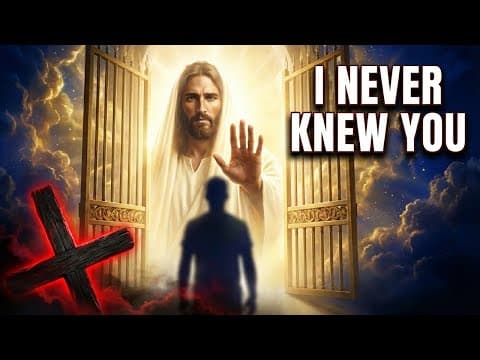
Matthew 7:23 Explained: 5 Signs Jesus Will Say "I Never Knew You"
"I never knew you; depart from Me" — Jesus spoke these words about people who prophesied and did miracles in His name. What does Matthew 7:23 really mean, and how can you be sure it will never be said to you? Here are 5 warning signs from the passage itself.
There is a verse in the Bible that should stop every churchgoer in their tracks. Jesus is describing the day of judgment — and the people He turns away are not atheists, criminals or scoffers. They are ministry people:
"Many will say to Me in that day, 'Lord, Lord, have we not prophesied in Your name, cast out demons in Your name, and done many wonders in Your name?' And then I will declare to them, 'I never knew you; depart from Me, you who practice lawlessness!'" — Matthew 7:22–23
What does Matthew 7:23 actually mean? In short: Jesus is warning that religious activity — even impressive, supernatural-looking activity — is not the same thing as a saving relationship with Him. The people in this scene called Him "Lord," served in His name, and were still strangers to Him. Their tragedy was not a lack of religion; it was a lack of relationship.
This is the final study in our series on the assurance of salvation, alongside 7 signs you are not saved and 3 signs your struggle proves you are truly saved. Let's walk through the passage carefully, because Jesus Himself embedded the warning signs in His own words.
What Does "I Never Knew You" Actually Mean?
At first glance the phrase seems strange. Jesus is God — He knows everything about everyone (John 2:24–25). How can He say He never knew them?
The answer is in the word itself. The Greek verb here, ginōskō, is not about information — it is the Bible's word for intimate, covenant relationship. It is the word used of the closest human relationships, and it is how God describes His bond with His people: "The Lord knows those who are His" (2 Timothy 2:19).
So Jesus is not saying, "I lack data about you." He is saying, "We never had a relationship. You spoke about Me, worked for Me, wore My name — but you never actually belonged to Me." Notice also the word never: these people did not lose their salvation; they never possessed it. From beginning to end, the relationship existed only in their imagination.
With that understood, the passage and its context reveal five marks of the people who will hear these words. Read them slowly — not for someone else, but for yourself, as Scripture commands (2 Corinthians 13:5).
Prefer to watch? This study is also available as a video:
Sign #1: Your Christianity Is All Words and No Obedience
The warning begins one verse earlier:
"Not everyone who says to Me, 'Lord, Lord,' shall enter the kingdom of heaven, but he who does the will of My Father in heaven." — Matthew 7:21
The contrast is stark: saying versus doing. These people had the vocabulary of faith — they even doubled the title, "Lord, Lord," a form of emphasis and devotion. But Jesus asks the piercing question elsewhere: "Why do you call Me 'Lord, Lord,' and not do the things which I say?" (Luke 6:46).
A "Lord" you do not obey is not actually your Lord — He is your mascot. If Jesus' commands carry no real weight in your decisions — your money, your relationships, your speech, your private life — then calling Him "Lord" on Sunday is precisely the empty profession this verse condemns.
Sign #2: You Are Trusting Your Religious Résumé
Look at the defense they present: "Have we not prophesied... cast out demons... done many wonders?" Every argument is an achievement. Their hope is built entirely on their spiritual CV.
Two sobering truths hide here. First, their claims may have been true. Scripture shows that God can work through people whose hearts are far from Him — Balaam prophesied truly (Numbers 24), King Saul prophesied (1 Samuel 10:10), and Judas was sent out to cast out demons with the other apostles (Matthew 10:1–4). Gifts are not grace. Power is not proof.
Second, notice what is missing from their defense: any mention of Christ's work. No cross. No blood. No mercy. The saved sinner's only plea is "Christ died for me" (Galatians 6:14); the false convert's plea is a list of his own deeds. On that day, the difference between those two answers will be the difference between heaven and hell.
Sign #3: You Claim Grace While Practicing Lawlessness
Jesus does not merely say "depart from Me" — He names the reason: "you who practice lawlessness." The word (anomia) literally means living as if there were no law, no King whose will binds you.
Here is the frightening combination this verse exposes: high religious activity and habitual, unrepented sin, coexisting comfortably in the same life. The New Testament calls this turning "the grace of our God into lewdness" (Jude 4) — using forgiveness as a license to keep sinning.
Be careful here, because Scripture makes a crucial distinction we covered in detail in our study on the believer's struggle: the true Christian fights sin and grieves over it; the false convert practices it — settled, strategized, undisturbed. It is not the presence of sin that marks the lost, but the comfortable practice of it.
Sign #4: You Serve Jesus Publicly but Never Meet Him Privately
Strip away the miracles from these people's story and ask: what was their relationship with Jesus when no one was watching? By His own testimony — nothing. "I never knew you."
This is perhaps the most practical warning in the passage for ordinary churchgoers. It is entirely possible to sing about Jesus, serve in ministries, even teach others — and never actually talk with Him, never sit in His Word to hear Him, never walk with Him through an ordinary Tuesday. Jesus described His true sheep in exactly relational terms:
"My sheep hear My voice, and I know them, and they follow Me." — John 10:27
Hearing. Being known. Following. Daily, personal, ongoing. If your entire spiritual life happens in public and nothing happens in private, you are living the profile of Matthew 7:22.
Sign #5: You Hear the Word but Never Build On It
Jesus did not end the sermon at verse 23. He immediately told the story that explains everything — two builders, two houses, one storm:
"Whoever hears these sayings of Mine, and does them, I will liken him to a wise man who built his house on the rock... Now everyone who hears these sayings of Mine, and does not do them, will be like a foolish man who built his house on the sand." — Matthew 7:24, 26
Notice: both men heard. Both houses looked similar in good weather. The difference — invisible until the storm — was the foundation, and the foundation was doing something with what they heard. The false convert is a lifetime hearer: sermons, videos, articles like this one, decades of biblical input with no obedient output. The storm of judgment reveals what sunny Sundays never could.
The Good News: You Can Be Known by Him Today
If these five signs describe you, hear this clearly: the most dangerous response is to feel a chill and change nothing. But the door is still open — the very fact that you are reading this warning before "that day" is the mercy of God.
And here is the glorious reversal the gospel offers. Salvation is not achieving enough to be accepted; it is being known:
"But now after you have known God, or rather are known by God..." — Galatians 4:9
Come to Christ honestly, today. Abandon the résumé. Confess that your religion was a house on sand, repent of your sin, and trust entirely in His death and resurrection for you (Romans 10:9). To everyone who comes this way, Jesus makes the promise that answers Matthew 7:23 forever:
"And I give them eternal life, and they shall never perish; neither shall anyone snatch them out of My hand." — John 10:28
Known. Kept. Never cast out (John 6:37). That is the opposite of "depart from Me" — and it is offered to you now.
Final Thoughts: Settle It Before That Day
"I never knew you" are the most terrifying words in the Bible precisely because they will be spoken to people who never saw them coming. Do not be one of them. Trade saying for obeying, the résumé for the cross, public performance for private communion, and hearing for building.
Examine yourself while it is called today — and if you find sand under your house, the Rock is one honest prayer away.
What about you? Which of these five signs made you stop and think? Share it in the comments on our YouTube channel — and send this study to someone who calls Jesus "Lord" but may never have met Him.
Last updated on October 19, 2026

Written by
Daily Scripture Study
Daily Scripture Study helps believers grow closer to God through in-depth Bible teachings, practical devotionals and honest answers to the hard questions of the Christian life. Every article is rooted in Scripture and written to encourage your daily walk with Christ.
Subscribe on YouTube →